n8n vs Manus AI: Which One Actually Fits How You Work in 2026?
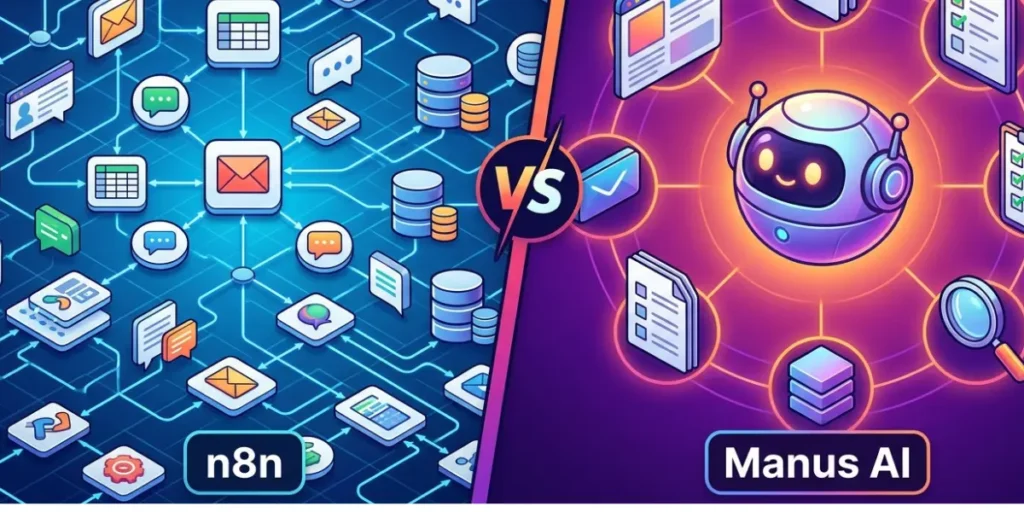
If you’ve landed here, you’ve probably already watched a demo of both tools. You’re likely thinking, “Okay, but which one do I actually need?” Fair question. n8n and Manus AI get lumped together because they both promise to take work off your plate. But they solve completely different problems. One is a workflow builder you control node by node. The other is an agent you talk to like a very capable, occasionally unpredictable employee. This n8n vs Manus AI comparison is here to get you an actual answer, not another feature list copy-pasted from the docs.
n8n vs Manus AI at a Glance
| n8n | Manus AI | |
| What it is | Visual, node-based workflow automation tool | Autonomous AI agent that plans and executes tasks |
| Learning curve | Moderate: you’re building logic, not just prompting | Low: you describe what you want in plain English |
| Pricing | Free self-hosted, paid cloud tiers | Credit-based subscription |
| Control | High: you define every step | Low: the agent decides how to get there |
| Best for | Repeatable processes across multiple apps | One-off or bounded tasks that need judgment |
| Deployment | Self-hosted or cloud | Managed platform only |
Need something to run the same way, every time, across your CRM, inbox, and spreadsheets? That’s n8n. Need something to figure out how to do a task you’d otherwise do yourself, like research a topic, draft a deck, or comb through a lead list? That’s Manus AI.
Now let’s get into why.
What Is n8n?
n8n is an open-source automation platform. You build workflows by connecting “nodes” on a canvas: a trigger node (say, a new row in Google Sheets), some logic nodes (if this, then that), and action nodes (send a Slack message, update a CRM record, call an API). Think of it as the spiritual successor to Zapier. Except you can see and edit the actual logic, and you can run it on your own server for free.
Here’s what makes it different from a simple “if this then that” tool: you can drop an AI step inside the workflow. Say you’re processing inbound support tickets. n8n can pull the ticket, send the text to an LLM node to classify urgency and draft a reply, then route it based on that classification. Low-priority stuff gets auto-sent. Anything involving a refund gets flagged for human review. The AI does one job. n8n owns the rest: the trigger, the routing, the retries if an API call fails, the audit trail.
That’s the core idea. n8n gives you the control. AI is a tool you plug into a process you designed, not the thing running the show.
The tradeoff is setup time. You need to understand triggers, nodes, and at least basic JSON to do anything beyond the pre-built templates. It’s learnable in a weekend if you’re comfortable with spreadsheets and APIs. But it’s not zero-effort.
What Is Manus AI?
Manus AI flips that model. Instead of building a workflow, you give it a goal in plain language. Something like: “Find 20 SaaS companies in the fintech space with under 50 employees, pull the founder’s LinkedIn, and draft a personalized cold email for each.” Then it works the task itself. It gets its own virtual computer: a sandboxed browser, file system, and the ability to install tools as needed. You’re not designing the steps. You’re reviewing the output.
That’s a genuinely different category of product. n8n executes a process you specify. Manus figures out the process itself. That makes it good at open-ended, judgment-heavy tasks and worse at anything where you need guaranteed, identical behavior every single time.
A Note on Manus’s Ownership
Worth knowing before you commit to it: Manus’s ownership has been unusually turbulent for a tool this young. Meta announced a roughly $2 billion acquisition of Manus in December 2025. Four months later, in April 2026, China’s National Development and Reform Commission ordered the deal unwound. The stated reason was export-control and national security concerns. Manus has Chinese origins despite relocating to Singapore. Meta spent the following months separating its operations from Manus, cutting off internal data sharing by mid-2026. As of August 2026, Manus has confirmed it’s returning to independent operation.
Practically, this matters if you’re planning to build anything durable on top of Manus. Ownership changes tend to precede pricing changes, feature shifts, or roadmap pivots. The platform is stable and shipping right now: it launched a Desktop app with local file and terminal access earlier this year. Still, it’s fair to keep half an eye on where it lands as an independent company again.
n8n vs Manus AI: Feature-by-Feature Comparison
Control and Customization
With n8n, you decide exactly what happens at every step: which field maps to which, what triggers a retry, what counts as an error. With Manus, you’re trusting the agent’s judgment on how to complete the task. That’s faster to set up but harder to predict. If a workflow absolutely cannot deviate (say, a compliance-sensitive process), n8n’s explicit logic wins every time.
Integrations
n8n has over 400 pre-built nodes covering everything from Airtable to Zendesk. Its HTTP Request node lets you hit literally any API that exists. Manus connects natively to a smaller set of commonly used apps: Gmail, Google Drive, Slack, Shopify, and a growing list of others. That covers most individual and small-team use cases. It won’t match n8n’s breadth for niche or internal tools.
Data and Privacy
n8n can be self-hosted, meaning your data never leaves your own server. That matters if you’re in healthcare, legal, or finance. Manus is a managed platform, so your data runs through their infrastructure. That’s a bigger consideration given the ownership changes mentioned above. If you’re handling sensitive customer data, read the actual terms instead of assuming.
Output Type
n8n produces actions: a record updated, a message sent, a file moved. Manus produces deliverables: a written report, a slide deck, a working script, a completed purchase. They’re not really competing for the same output. One automates a process. The other completes a task.
Reliability Under Failure
n8n lets you build explicit retry logic, fallback paths, and human-approval checkpoints before anything irreversible happens: sending a customer email, charging a card. Manus handles failure inside its own agent loop. It’ll retry or adapt on its own, but you get less visibility into what it tried and why, unless you’re watching the session live.
n8n vs Manus AI Pricing: What Will This Actually Cost You?
This is the part most comparisons skip. It’s usually the deciding factor.
n8n is free if you self-host on your own server. You just cover hosting costs, which can run a few dollars a month on a basic VPS. Cloud plans start at a tier suitable for a handful of active workflows and scale up based on execution volume. For most solo users and small teams, self-hosting is genuinely free beyond server costs. The catch: you need to know enough to set up and maintain that server.
Manus AI runs on a credit-based subscription. You pay for a plan, and tasks consume credits based on complexity and runtime. A quick research summary costs less than a multi-hour agent session building out a full CRM. Worth noting: Manus was free with generous limits during its early access period. That changed once it scaled, so budget for ongoing cost per task rather than a flat rate.
Rough monthly scenarios:
- Solo creator drafting content and doing light research: Manus AI’s entry tier is usually cheaper and faster to start with than setting up n8n for the same job.
- Small team automating lead routing, CRM updates, and internal notifications: n8n’s free self-hosted tier (or its lower cloud tier) is significantly cheaper long-term. You’re running the same workflow thousands of times a month, and credit-based pricing adds up fast at that volume.
- Agency or business running both ongoing processes and one-off research tasks: Budget for both. They’re not really substitutes.
n8n vs Manus AI Hands-On Test: Building the Same Task in Both Tools
Theory is nice, but let’s actually run something through both. The task: take a list of 15 cold leads (name, company, LinkedIn URL) and produce a personalized first-touch email for each.
Running It in n8n
I set up a Google Sheets trigger that reads new rows, an HTTP Request node to pull basic company info, an OpenAI node with a prompt template referencing the row data, and a final node that writes the drafted email back into the sheet for review. Setup took about 40 minutes. Most of that time went into getting the prompt template to correctly reference each field. Once built, it ran all 15 rows in under two minutes. I can now drop in a new lead list any time and get the same consistent format every time. The downside: when the LinkedIn scrape node hit a rate limit, the whole run stalled. Adding a retry delay to catch that was on me.
Running It in Manus
I gave it the same 15 leads and one instruction: “Research each person’s company and role, then draft a short, personalized cold email referencing something specific about their business.” No setup time. It started immediately, browsing each LinkedIn profile and company site on its own. It took roughly 12 minutes to complete all 15. The emails were noticeably more specific than n8n’s output. It picked up on things like recent funding rounds or product launches that weren’t in my spreadsheet at all, because it went and found them itself. The tradeoff: two emails referenced slightly outdated information, like an old job title. I only caught it because I was reviewing all 15 anyway.
The Honest Takeaway
n8n wins on repeatability and consistency. Build it once, run it forever, identical format every time. Manus wins on initial quality and zero setup. It does research you didn’t ask for and produces better first drafts, but you still need to spot-check its output. For a recurring weekly task, I’d build it in n8n. For a one-time push on a specific campaign, I’d just run it through Manus.
Who Should Use n8n vs Manus AI?
Choose n8n If You’re…
- A developer or startup building internal tooling or a product feature. n8n gives you the control and self-hosting to build something you actually own long-term, without vendor lock-in.
- A student or educator/researcher who wants a genuinely useful technical skill, especially if you’re studying automation or data pipelines.
Choose Manus AI If You’re…
- A content creator or freelancer who needs research, drafts, or deliverables fast and doesn’t want to learn workflow logic. Manus gets you a usable first draft with almost no setup.
- A business owner without a technical background. Manus’s plain-language interface has a far shorter path to your first useful result. n8n is learnable, but it’s a real time investment starting from zero.
- A student or researcher doing source synthesis and summary work.
Use Both If You’re…
- A digital marketer. Realistically, you’ll want both: Manus for campaign research and content drafts, n8n for the recurring stuff like scheduled posting, lead scoring, and CRM syncs.
- A designer. Neither tool is core to your workflow, but Manus can generate briefs, mood-board research, or copy drafts quickly. n8n can automate the boring parts around design work, like client onboarding forms and asset delivery.
n8n vs Manus AI: Can You Use Both Together?
Yes. This is where most people miss an opportunity: they treat it as either/or.
A workable pattern: let Manus handle the part that needs judgment and research. Let n8n handle the part that needs to happen the same way every time. For example, Manus researches and drafts a weekly newsletter based on trending topics in your niche. Once you’ve reviewed and approved it, an n8n workflow picks up the final draft, formats it, schedules it across email and social, and logs the send in a tracking sheet. Manus does the creative, judgment-heavy work once. n8n handles the repeatable distribution mechanics every week without you touching either tool again.
This split plays to what each tool is actually built for, instead of forcing one to do the other’s job.
Frequently Asked Questions
Is Manus AI still owned by Meta?
No. Meta’s planned $2 billion acquisition was blocked by Chinese regulators in April 2026 on national security grounds. Meta separated its operations from Manus through mid-2026, and as of August 2026, Manus has confirmed it’s returning to independent operation.
Is n8n free to use?
Yes, if you self-host it, you only pay for your own server hosting. n8n also offers paid cloud plans if you’d rather not manage your own infrastructure, priced based on workflow volume.
Can n8n replace Manus AI, or vice versa?
Not cleanly. n8n automates a defined process; Manus completes an open-ended task using its own judgment. They solve different problems, and many teams end up using both for different parts of their work.
Is Manus AI safe for business or customer data?
It’s a managed platform, so your data runs through their infrastructure rather than staying on servers you control. Given the recent ownership changes, it’s worth reading their current data-handling terms directly before feeding it sensitive customer information, especially if you’re in a regulated industry.
Which is easier to learn with no coding experience?
Manus AI, by a wide margin; you interact with it in plain language. n8n has a visual interface too, but building anything beyond a basic template usually means understanding triggers, conditional logic, and often a bit of JSON.
Do I need to know how to code to use n8n?
No, but it helps. n8n is designed to be low-code, and plenty of people build solid workflows without writing a line of code. That said, debugging a broken workflow, especially one involving APIs, goes a lot faster if you can read JSON and understand basic request/response structure.
What happened with the Meta-Manus deal?
Meta announced its acquisition of Manus in December 2025. China’s regulators investigated the deal over export-control concerns and formally ordered it unwound in April 2026. Meta began separating its systems from Manus over the following months, and Manus confirmed in August 2026 that it’s returning to independent operation.
Final Verdict: n8n vs Manus AI
Want a process that runs the same way every time, across the tools you already use (email, CRM, spreadsheets, Slack)? Build it in n8n. Want to get a task done, with some judgment and research baked in, without spending an afternoon building the logic yourself? Manus AI gets you there faster. Most people reading this will eventually want both: n8n for the repeatable backbone of your operations, Manus for the one-off, judgment-heavy work that doesn’t fit neatly into a flowchart.
Start with whichever matches the task in front of you this week. You’ll know within a day which one you reach for next.