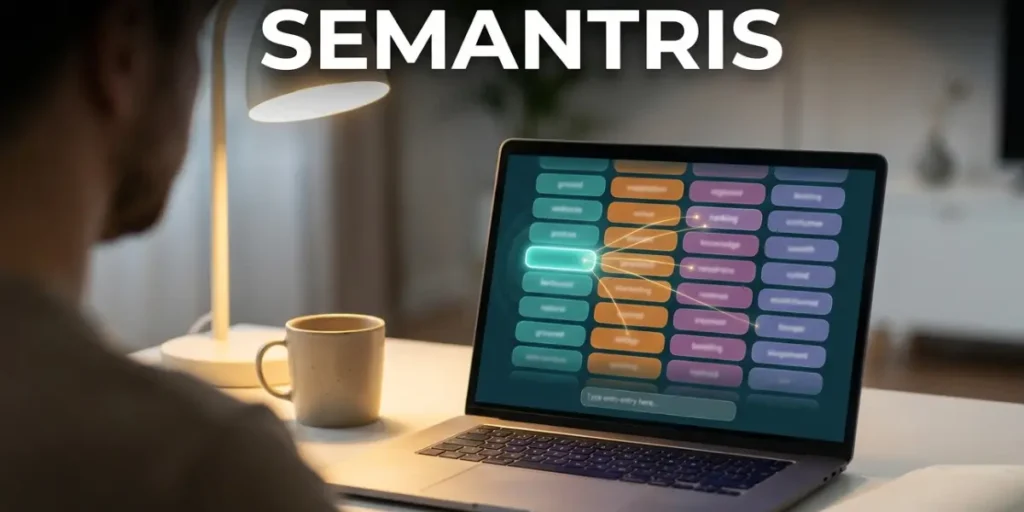

Semantris is a word association game from Google that tests how well you think like an AI. You type a clue, and the game ranks every word on screen by how closely it matches your meaning. Google launched it in April 2018 as a public demo of semantic search.
What Is Semantris?
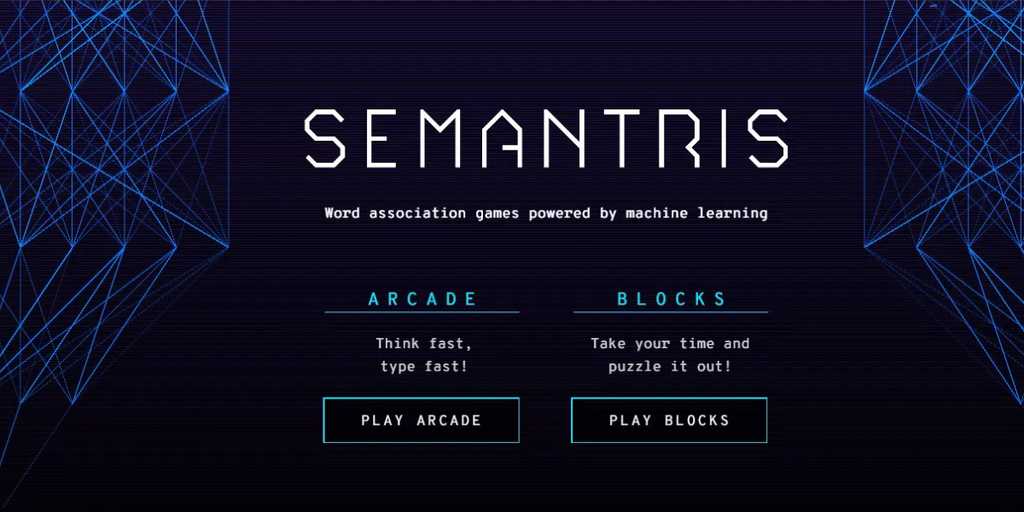
The Semantris game is a set of two word association games. Google released it in April 2018 on its Semantic Experiences site, next to a tool called Talk to Books. Both demos showed everyday users what machine-learned language understanding can do.Like other vocabulary learning tools, Semantris helps users explore connections between words, although it focuses on AI-powered word association rather than traditional flashcards.
Google trained the model on billions of examples of conversational text. Because of that, it links words across many topics, not just obvious synonyms. The name blends “semantics” and “Tetris,” according to Gizmodo Japan. A TechCrunch writer thought the game was too simple to deserve the “-tris” ending. Still, the writer called it a nice little time waster.
Google still lists the game on its AI Experiments site, where you can play it in a browser.
How Semantris Works
Both modes follow the same loop. Words sit on screen, and you type a clue. The AI scores every word by how well it fits your clue, then reorders them. Google’s research blog says you can enter a word or a phrase, so you aren’t stuck with single words.
Take “forest” as the target. A clue like “trees” scores high because the two words sit close together in meaning. The game rewards the closest link, not just any link.
Semantris Game Modes: Arcade and Blocks
Arcade Mode
Arcade is the fast mode. Words stack up on screen, and the game highlights a target. You type a clue, and the AI drops the closest matches toward the bottom. When the target lands there, it blows up along with a few other words. New words then arrive. The pace climbs as you go, so hesitation costs you.
Blocks Mode
Blocks is turn-based and calmer. Colored blocks hold words, and your clue clears the block with the best match. It also clears the same-colored blocks around it. Sometimes the AI clears a word you never expected, so planning feels a little like a gamble. One writer sums up the split neatly: pick Arcade for pressure and Blocks for strategy.
How to Play Semantris
- Open the game page on Google’s AI Experiments site (experiments.withgoogle.com/semantris).
- Choose a mode. Pick Arcade for speed or Blocks for a slower puzzle.
- Read the target. In Arcade, find the highlighted word. In Blocks, look for a cluster of same-colored blocks.
- Type a clue. Use a word or short phrase that captures the target’s meaning.
- Check the reshuffle. Watch where the AI moves each word, then adjust your next clue.
Semantris Tips: How to Score Higher
Google doesn’t publish an official scoring guide. These tips follow how the game ranks words.
- Pick the most common link. The model learned from everyday conversation. An ordinary clue like “trees” is usually a safer bet for “forest” than a rare word.
- Scan the whole screen. The game ranks all words at once. A clue that also fits a neighboring word can push the wrong word down, so read the other words before you type.
- Try a short phrase. If a single word fails, a phrase can add the context the model needs.
- Aim for clusters in Blocks. A good clue clears the target and its same-colored neighbors. Target words that sit in the largest same-colored group.
- Keep clues simple in Arcade. Speed matters there, and overthinking burns time.
The Technology Behind Semantris
The game relies on sentence-level language models, not keyword matching. Google published the Universal Sentence Encoder paper in March 2018, and the Semantic Experiences launch pointed to its models. The paper describes two encoders. One uses the transformer architecture, and the other uses a deep averaging network.
Each encoder turns an English string into a fixed-length list of numbers called an embedding. Texts with the same meaning are close to each other in that numeric space. Google also released pre-trained TensorFlow modules to help developers build their own custom versions.
In simple terms, the game measures distance. Your clue becomes numbers, and so does every word on screen. The closest match wins. The same vector idea now powers much of modern semantic search, so the game doubles as a friendly lesson in how it works. AI is also changing how people learn languages and interact with educational platforms. Our article on the Duolingo AI controversy explores another example of AI’s growing role in education.
Can a Bot Beat Semantris?
Developer Pravendra Singh built a program called Semantris-Solver. It captures the screen with OpenCV and finds the highlighted word. Then it uses Word2Vec vectors trained on Google News to pick an associated word. Finally, it types that word into the game.
The public repository supports only Arcade mode, and the word model takes 5 to 10 minutes to load. Singh’s write-up notes that both modes lean on pattern recognition. That makes the game a neat case where humans and machines compete on the same skill: judging meaning.
Semantris Alternatives: Semantle and Contexto
Several newer games use the same idea. David Turner created Semantle in January 2022. It asks you to find a daily secret word, and after each guess it shows a similarity score based on Word2vec. Nildo Junior built Contexto to feel simpler than Semantle. It ranks each guess by closeness to the secret word, where rank 1 is the answer.
Both games offer one secret word daily. Semantris plays in real time with a stack of words instead. As a result, it feels more like Tetris than Wordle.
Also read:
Frequently Asked Questions
What is Semantris?
A: It is a pair of word association games from Google. You provide the clues, and an AI instantly ranks the available words by their relevance.
Who made Semantris? Google’s research and AI teams built it. It launched in April 2018 alongside Talk to Books on the Semantic Experiences site.
Is Semantris free to play? It runs in your browser as a public Google experiment. Neither Google’s listing nor the launch coverage mentions a fee.
What are the two Semantris modes? Arcade and Blocks. Arcade is fast and real-time. Blocks is turn-based and rewards planning.
How does Semantris determine word similarity? Google trained a language model on billions of examples of conversational text. The model turns words and phrases into numbers, then compares how close they sit.
Does Semantris use my answers to train the AI? Launch coverage doesn’t say. A TechCrunch writer raised the question in 2018, but the article includes no reply. Check Google’s privacy terms if it matters to you.
Bottom Line on Semantris
Semantris turns a serious research idea into a quick game. Instead of checking your spelling, the AI evaluates the actual meaning behind the clue you type. Arcade tests your speed, while Blocks tests your planning. Either way, you see how machines read language. Try both modes, keep your clues simple, and scan the whole screen before you type