Duolingo AI Controversy: The Full Timeline, the Backlash, and What Changed
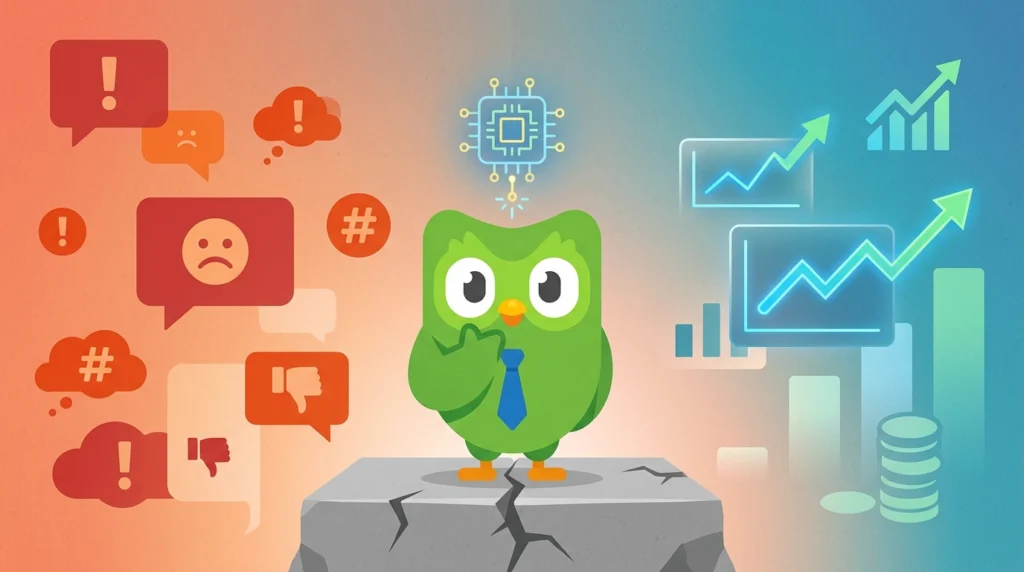
If you only saw the headlines from spring 2025, you’d think Duolingo torched its own brand overnight. Boycott threats, deleted app streaks, a CEO walking back his own memo on national television. But most coverage misses what happened next. The Duolingo AI controversy didn’t just fade out. It went through a second act in 2026 that resolved a lot of the original argument.
Here’s the full timeline, what each side actually said, and where things stand now.
What Sparked the Duolingo AI Controversy
It started with an internal email. On April 28, 2025, Duolingo CEO Luis von Ahn sent an all-hands message announcing the company would become “AI-first.” He shared the letter on LinkedIn the same day.
The email laid out three changes. Duolingo would gradually stop using contractors for work AI could handle. AI use would factor into hiring decisions. And it would become part of performance reviews going forward. Von Ahn compared the shift to Duolingo’s early bet on mobile back in 2012, framing AI adoption as the same kind of make-or-break moment.
The email also included reassurance. Von Ahn wrote that the change wasn’t about replacing employees with AI, but about removing bottlenecks so existing staff could do more. That reassurance got buried fast under the phrase that actually spread: “AI-first.”
Timeline: How the Backlash Unfolded
April 28, 2025 — The AI-first memo goes public on LinkedIn. Reaction is swift. Users start discussing a boycott on social media. Some post about deleting their accounts and giving up multi-year learning streaks as a form of protest.
Around the same time — A separate but oddly-timed incident adds fuel. A viral stunt shows Duolingo’s owl mascot, Duo, appearing to get struck by a Tesla truck, and it spreads fast across TikTok. It has nothing to do with the AI announcement, but it lands in the middle of the backlash and blends into the same wave of negative attention toward the brand.
Early May 2025 — Duolingo pulls back its social media presence after user comments turn overwhelmingly negative. The company reportedly removes a batch of its own TikTok videos.
May 8, 2025 — Von Ahn goes on the No Priors podcast and makes the backlash worse. He suggests AI may teach better than humans because it can personalize instruction, and predicts AI could take over classroom teaching within a few years. Critics point out there’s little scientific evidence behind that specific claim.
Through summer 2025 — Despite the outrage, Duolingo’s quarterly financials stay strong. Von Ahn later acknowledges the AI commentary dampened what would have otherwise been even stronger user growth.
August 2025 — Facing continued criticism, von Ahn gives an interview attempting to walk back the framing, not the substance. He tells reporters the memo wasn’t controversial internally, and that the external reaction assumed intentions that weren’t there.
What Duolingo Actually Said vs. What Users Heard
A lot of the controversy came down to a gap between the literal memo and how people read it. Von Ahn consistently repeated one core claim: Duolingo had never laid off a full-time employee in its entire 17-year history, and AI was replacing certain contractor work, not staff jobs.
Users heard something different. They heard a language-learning platform announcing it would prioritize AI over the humans, including translators, linguists, and course writers, who had shaped the product for years. Duolingo’s entire value proposition rests on trust in the quality and authenticity of its content. That’s why the memo read as a threat to the product itself, not just an internal HR policy shift.
Both readings had some basis. Duolingo’s contractor workforce did shrink as AI took over parts of course production. Whether that counts as “replacing humans” or “adjusting contractor allocation” became the real fight, more than the AI itself.
Did the Backlash Actually Hurt Duolingo’s Business?
Not in the way the boycott threats suggested it would. Duolingo closed out 2025 with more than 50 million daily active users, over $1 billion in bookings, and its first year crossing $300 million in adjusted EBITDA. Course production scaled dramatically too. The company published roughly 20,500 course units in the first quarter of 2026 alone, up from about 7,100 per quarter throughout 2025.
That doesn’t mean the backlash was empty noise. Von Ahn has acknowledged that the AI-first commentary dampened user growth compared to what it likely would have been without the controversy. The company still grew. It just grew somewhat slower than it otherwise might have.
The 2026 Walkback: Duolingo Scraps the AI-Usage Rule
The part of this story most articles miss happened over a year after the original memo. In a May 13, 2026 interview on the Rapid Response podcast, von Ahn revealed that Duolingo had quietly dropped the performance-review rule tying employee evaluations to AI usage.
His reasoning: employees kept telling leadership they felt pressured to use AI tools just to check a box, not because the tools actually helped their work. Von Ahn called this using AI “for AI’s sake,” and said that outcome wasn’t what the original policy was meant to produce.
He also made a rare admission about quality. Duolingo needs roughly a thousand short stories per language for its content library. Von Ahn said around 20% of AI-generated stories come out unusable and need scrapping or rewriting. That’s a notably candid number for a company that spent the past year insisting AI hadn’t compromised quality.
Headcount, notably, kept growing the entire time, including through the year of the original controversy. Von Ahn has repeatedly pointed to this as evidence that “AI-first” was never a euphemism for layoffs at Duolingo specifically, even as other tech companies used similar language while cutting staff.
The Bigger Debate Behind the Duolingo AI Controversy
Strip away the specifics of one company, and this fight reflects a broader argument playing out across tech and education right now.
The case for Duolingo’s approach: AI let the company scale course production nearly threefold without a matching increase in headcount, expanding language coverage faster than a purely human content pipeline ever could manage. Supporters argue that faster, cheaper content production ultimately benefits learners through more languages, more course variety, and lower subscription costs. They also see adjusting contractor allocation as tools improve as a normal, defensible business decision, not a betrayal of workers.
The case against it: Critics argue that language learning is fundamentally a human skill, one best taught and refined by humans. They see the reliance on AI-generated content, later admitted to carry a real error rate. Labor advocates also push back on “we never laid off full-time employees” as a framing that sidesteps a separate question: what happened to the contractors, many of whom did lose steady work. They argue the framing matters less than the actual reduction in paid human labor.
Neither argument fully cancels the other out. Reasonable people land in different places depending on how much weight they put on quality, labor conditions, or business efficiency.
What This Means for Duolingo Users Today
If you’re using the app now and wondering whether the controversy should change how you use it. A few practical things are worth knowing. Duolingo Max, the higher subscription tier. Leans on generative AI for features like open-ended conversation practice, and that feature has genuinely improved since the initial backlash. Course content quality varies more than it used to. Because AI-authored material now makes up a larger share of newer courses, especially for less common languages where course libraries expanded fastest.
If you’ve noticed inconsistent quality in a specific course, that doesn’t necessarily signal a general product decline. It may just reflect the roughly 20% AI-content error rate von Ahn has since admitted to, and that error rate concentrates in newer or lower-resource language tracks rather than spreading evenly across the whole platform.
Frequently Asked Questions
What did Duolingo’s CEO actually say about AI? In an April 2025 memo, Luis von Ahn announced Duolingo would become “AI-first,” gradually reducing contractor use for work AI could handle and factoring AI usage into hiring and performance reviews. He maintained the company never laid off full-time employees.
Why did people boycott Duolingo? Users reacted to the framing of the “AI-first” memo, which many read as prioritizing AI over the human translators, linguists, and content creators behind the platform’s quality. Some users deleted their accounts or long-standing learning streaks in protest.
Is Duolingo still AI-first in 2026? The company backed away from its formal AI-usage performance review policy in May 2026. It still uses AI extensively for course content production and features like Duolingo Max’s conversation practice.
Did the controversy actually hurt Duolingo’s business? Not severely. The company posted strong 2025 financials, including more than 50 million daily active users and its first year over $300 million in adjusted EBITDA. The CEO has acknowledged the controversy modestly dampened growth compared to projections, without derailing it.
The Bottom Line
The Duolingo AI controversy started as a PR crisis over one badly-framed internal memo. It evolved into a genuine, ongoing experiment in how much AI a content-heavy consumer product can absorb. A year later, the company admitted a meaningful share of its AI-generated content wasn’t usable, which suggests the critics weren’t entirely wrong to push back. At the same time, Duolingo kept growing, and it never touched full-time headcount, which complicates the narrative that this was simply AI replacing workers.
The most accurate read, a year on: Duolingo overcorrected in its messaging, underestimated how the phrase “AI-first” would land, and has spent the time since quietly walking the policy back toward what it originally claimed it meant all along.