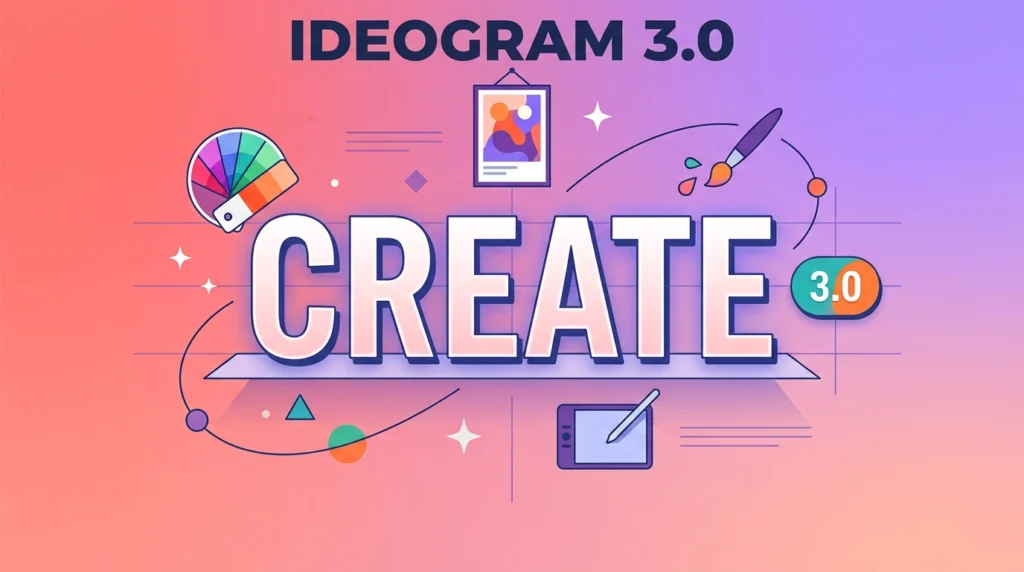
Ideogram 3.0: Complete Guide to Features, Pricing, and Whether It’s Still Worth Using
If you’re researching Ideogram 3.0 right now, there’s one thing worth knowing upfront: it’s no longer Ideogram’s newest model. The company released Ideogram 4.0 in June 2026, and it changes the calculus on whether 3.0 is still the right choice for your work. Stick around, because the answer is more interesting than “just use the newer one.”
Here’s everything Ideogram 3.0 actually does, what it costs, and where it still makes sense to use even with a newer model on the table.
What Is Ideogram 3.0?
Ideogram 3.0 is a text-to-image AI model built by Ideogram AI, first released on March 26, 2025, with a refinement update following in May 2025. It’s designed around a specific strength most competing image generators still struggle with: rendering accurate, legible text directly inside generated images. That makes it a favorite for graphic design work like posters, logos, product packaging, and social graphics. Where the image needs to include real, readable words rather than garbled AI-text soup.
Ideogram 3.0 was officially described by the company as “our most advanced model” at launch, bringing meaningful jumps in photorealism.
Key Features That Made Ideogram 3.0 Stand Out
Style Reference. You can upload up to three reference images, and Ideogram 3.0 will match its output to that visual style instead of relying purely on a text description. This solves a real problem: describing an aesthetic in words is hard, and showing the model an example gets far more consistent results.
Random Style with 4.3 billion presets. Ideogram built a massive library of style combinations you can randomly explore, then save the ones that work using a reusable Style Code. Once you find a look you like, you can apply that exact code to future generations.
Improved text rendering. This remains Ideogram’s core differentiator. Version 3.0 handles longer and more complex text within images, including multi-line layouts, with noticeably fewer garbled letters or broken words than competing models.
Magic Fill and Extend. These editing tools let you modify part of an existing image or expand its canvas outward, all inside Ideogram’s Canvas editor, on both uploaded images and ones you generated with the model.
Batch Generation. Aimed at professional and business use, this feature lets you generate multiple image variants at once, useful for producing several ad creative options or product mockups in a single pass instead of one at a time.
Ideogram 3.0 vs. Earlier Versions (2.0 and 2a)
If you used Ideogram before 3.0, here’s what actually changed. Images produced more natural lighting and smoother gradients, reducing the flat or slightly artificial look common in the 2.x series. Text rendering, already Ideogram’s strength, got noticeably more reliable in longer and more complex layouts. Spatial composition improved too, meaning the model handles depth, layering, and multi-object scenes with better coherence than before.
None of this was a full rebuild. It was a refinement of what Ideogram already did well, rather than a fundamentally different model architecture.
How to Use Ideogram 3.0
- Go to ideogram.ai and sign in.
- Select the 3.0 model from the model picker, since the platform now also offers 4.0 by default in some flows.
- Write your prompt, including any exact text you want rendered inside the image, in quotes for clarity.
- Add a Style Reference if you want to match a specific aesthetic, uploading up to three example images.
- Generate and refine using Magic Fill or Extend if you need to adjust part of the output rather than starting over.
Ideogram Pricing in 2026: What 3.0 Actually Costs You
Ideogram’s pricing runs on a credit system, and the model you choose changes how far your credits go.
| Plan | Monthly Price | Credits | Cost per Image on 3.0 |
| Free | $0 | 10 slow credits/day | Public gallery only, roughly $0 |
| Basic | ~$8 | 400 priority credits | ~$0.02/image |
| Plus | ~$20 ($15 annual) | 1,000 priority credits | ~$0.02/image |
| Pro | ~$48–60 ($42 annual) | 3,200–3,500 credits | ~$0.02/image |
A standard Ideogram image costs 1 credit to generate, making it one of the most credit-efficient models on the platform. That efficiency matters more now that 4.0 exists, which brings us to the real question.
Ideogram 3.0 vs. Ideogram 4.0: Should You Still Use 3.0?
Here’s the part most guides skip. Ideogram released version 4.0 in June 2026 as an open-weight model, meaning developers can download and self-host it, alongside native 2K resolution and structured JSON layout control for precise design work. On paper, it’s the more capable model.
But there’s a real tradeoff most people researching “Ideogram 3.0” actually care about: cost. A default-quality image on Ideogram 3.0 costs 1 credit. The same image on Ideogram 4.0 costs 4 credits. If you’re on the Plus plan’s 1,000 monthly credits, that’s the difference between roughly 1,000 images on 3.0 versus about 250 on 4.0.
Stick with Ideogram 3.0 if: you’re producing high volumes of text-heavy graphics, like social posts or ad variants, where credit efficiency matters more than squeezing out the last bit of photorealism or resolution.
Move to Ideogram 4.0 if: you need native 2K output, are building a developer workflow around structured JSON layout control, or want the option to self-host the model on your own infrastructure.
For a lot of everyday design work, particularly anything centered on legible in-image text, Ideogram 3.0 remains the more practical choice purely on cost, even with a newer model available. fits naturally into work where the final image needs real, readable text: promotional posters with a headline baked into the graphic, product packaging mockups, social media quote graphics, and logo concepts where the wordmark needs to render cleanly rather than as an approximation. It’s less suited to pure photorealistic portraiture or fine-art style generation, where models built specifically for that purpose tend to edge it out.
Ideogram vs. Competitors
Against Midjourney, Ideogram 3.0 trades some artistic polish for dramatically better text accuracy and a lower price point at every tier. DALL-E, Ideogram offers a dedicated per-image API pricing structure that remained available even after OpenAI scaled back its own image API access. Against Adobe Firefly, Ideogram lacks the built-in Creative Cloud integration but generally wins on standalone text rendering quality.
If accurate in-image text is your main requirement, Ideogram, including version 3.0 specifically for cost reasons, remains one of the strongest options in the category.
Frequently Asked Questions
Is Ideogram 3.0 still available in 2026? Yes. Even after the June 2026 release of Ideogram 4.0, version 3.0 remains selectable on the platform and continues to be the more credit-efficient option for high-volume generation.
Is Ideogram 3.0 free to use? Yes, with limits. The free tier gives you roughly 10 slow credits per day, enough for casual use, though generated images are public by default.
What’s the difference between Ideogram 3.0 and 4.0? Ideogram 4.0 is a newer, open-weight model with native 2K resolution and structured JSON layout control. It costs 4 credits per image compared to 3.0’s 1 credit, making 3.0 significantly cheaper for high-volume use.
Does Ideogram 3.0 support commercial use? Yes, commercial use is allowed on all Ideogram tiers, including the free plan, though free-tier images remain public in Ideogram’s gallery.
What is Ideogram’s biggest strength compared to other AI image generators? Text rendering accuracy. Ideogram consistently produces more legible, correctly spelled text inside generated images than most competing models. That’s why it’s popular for design work involving logos, posters, and branded graphics.
Bottom Line
Ideogram 3.0 isn’t Ideogram’s newest model anymore, but that doesn’t make it obsolete. Its combination of strong text rendering, a genuinely usable free tier, and low credit cost per image still makes it the more practical choice for a lot of everyday design work, especially anything produced at volume. If you need native 2K output or want to self-host, Ideogram 4.0 is the better fit. For most text-heavy graphic design tasks, 3.0 still earns its place in the toolkit.